



Glacier Bay 2640 Renegade
by David Pascoe
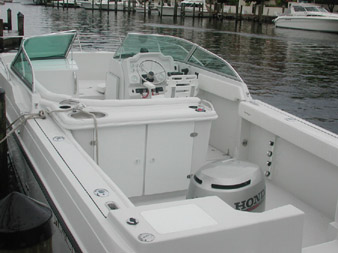
Since our last review of a Glacier Bay, Company President Larry Graff asked me to have a look at some of the new improvements that he's made across the board on his line of twenty six footers. Larry didn't mind telling me that he was disappointed with my review, suggesting that I was a little hard on his boats. I had to agree because the truth was that I am a bit prejudiced toward mono hulls for some very good reasons. Secondly, the last time we did a sea trial, the seas were far too big and steep for us to be able to evaluate the boat fully.
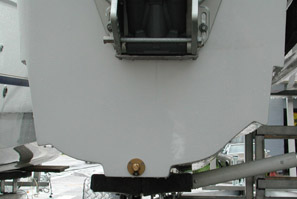
This time we had conditions that were a lot better for getting an all-around sense of how this boat performs. Namely, two foot very confused seas out in the Stream. Larry points out that he's made some refinements to the hulls. These involve angling the chines down a bit and reshaping the spray rails to reduce spray. In the stern section he, uh, well, take a look at the photo below because I'm not that skilled a technical writer that I can adequately explain what he did there. Whatever it was, it seems to have resulted in some great improvements in boat handling.
NOTE: There are four different models built around the same 26 foot hull. Our test boat was the 2640 Renegade. It was very light on fuel and therefore a bit bow heavy.
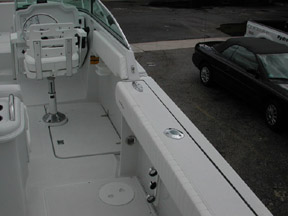
Other improvements include installing two frames in the hull sides to strengthen the gunwales which, I could see by giving it the old press with your feet test, did indeed increase the strength a lot. The width of the gunwale is also substantially wider. Cancel that former complaint. Some new hardware consisting of some great chromed bronze hatch dogs (latches for you landlubbers), along with a new type of plastic inspection ports that are both much larger and far better designed than the previous ones.
I liked the layout of this boat from the moment I saw it. What we got here is all the spaciousness of a pontoon boat without the accompanying unseaworthiness. The L-shaped lounge set forward is what makes it, freeing up a largish aft cockpit deck for water sports or, if you so desire, you can add additional seating such as folding chairs. But to be able to move around some uncluttered deck space was like pure heaven to me. I detest cramped and cluttered decks. Most small boats are too cramped with too much seating, and remind me of what it's like flying coach on a commercial airline.
The console behind the lounge is also very nice, particularly since there is enough surface space there to actually be useful, unlike so many boats of its size. Call it a bar area if you like, I'd probably use it as a work bench. What really made me gasp was the head compartment. It's unexpected, to say the least. One thing you'll notice is that here we have a 26 foot boat, but essentially no cabin -- except for the head space in the port hull. Is it weird? Is it cool. I'm not sure, but there is also a lot of dry storage space there.
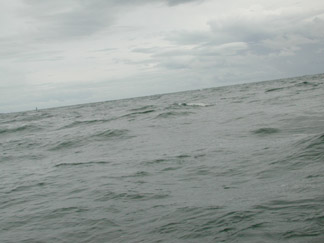
Our sea trial conditions.
Overall, I thought this was a wonderful open boat for the Florida market, and I'm sure that that's what Larry had in mind. It's great for waterway cocktail barging, or a quick blast over to the islands or down to the keys, and will get you there fast without breaking the bank. You will not, however, be sleeping aboard should you decide to overnight, unless it's under the stars.
Getting back to performance, our demo driver Len Renne jammed the throttles forward and stormed out the inlet at 26 knots into a tide rip. I won't say it was smooth riding, for no boat is smooth under those conditions, as shown above, but the way this boat handles waves head-on is impressive. For reasons I haven't had time to analyze, the bow does not lift as high as you would expect with a monohull. This reduces slamming considerably. This boat did slam on occasion, but most of the time it was more like a hard landing than a flat out belly flopper. Were the seas running from a consistent direction, I'm sure that it would handle a two foot chop superbly. Yet it did just fine with waves popping up from every direction.
Just so you understand wave height, keep in mind what a two foot high speed bump in the road would be like. Two feet is a big wave for a 26 footer, nearly the distance from the water line to the gunwale. I still find it hard to describe the handling characteristics of this boat. It's just plain different, but more pleasant than a typical monohull once you get over the fact that it doesn't behave like a monohull.
Off-the-wind handling was superb. As I said in my previous piece, operating a catamaran takes some getting used to. Under these sea conditions, the hulls tracked very nicely. Zooming along at full speed I was urged to throw the boat into a hard turn. As I used to do this as a kid just for kicks, I was leery at first but finally gave the wheel a big twist. Frankly, I found it hard to believe that a cat could slide into a turn, but it did so nicely.
We took very little spray over the bow, though it has an interesting tendency to shoot a very, very fine mist of spray over the bow. The space between the hulls is so narrow that waves do not smack against the web as the usually do on larger cats, but at slower speeds, say around 12-14 knots, it will shoot a geyser of water forward at times.
Rock-N-Roll Department: We hear a lot of talk about how much boats roll. It seems a lot of people are seeking the illusive "stable platform." But there is no such thing, all boats roll, the only question is in what manner. Bringing the boat to a stop on various points of the compass we found out. In terms of degrees of roll, this rolls much less than any comparable mono hull. But there is a great trade off for the speed of movement, for while it rolls less, it rolls much faster. Trying to stand up is no easier on a catamaran than it is on any monohull. The very rapid motion throws you off your feet regardless. If you want to go to sea, you just have to live with that.
The key to success of this design, at least in my mind, is the closeness of the two hulls. One could argue that this is not really a cat, but a slotted hull, and you wouldn't be too far off the mark. You could also argue that you loose a lot of hull interior space, which is certainly true. You can complain that the gunwales are too high, and that is also true. But in my view, all of these are tradeoffs for the superior performance. Then, again, counterbalancing the scale you also get that huge cockpit area which is facilitated by a rectangular deck area that does not come to a point on one end.
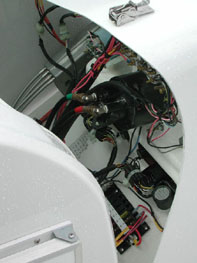
Helm console is hinged and swings out for easy access.
I also had a hard time getting used to the amazing quietness of the Honda 130 four stroke engines. They are so quiet that the sound they emit is more like a moderate hum; no roaring and we could even carry on a normal conversation without shouting. Without engine noise, this also gives you a new take on the perception of speed. I quickly learned that in docking, I normally rely upon engine noise to tell me what the engines are doing. Lacking that noise, you quickly discover that on docking you have a new learning experience on your hands. Fortunately, I managed not to crash into the dock. The wide spacing of the engines gives much better control than any other twin outboard boat where the engines are set as close as they can get.
When it came time to load back up on the trailer, I took one look at the boat, and then at the trailer and thought, uh oh, this is going to be a tough job. Then Len hopped in the boat and literally drove it ALL the way up onto the trailer. The trailer, you see, has teflon skids on it. The only problem here is to avoid driving the boat on top of your vehicle. It's almost too easy.
Whatever you may think of cats, their low power speed performance is undeniable. Two hundred-sixty horsepower pushes this boat to 31.7 kts in rough water. The speed range obtained is as follows:
| 3000 RPM | 16.8 kts. |
| 3600 | 19.8 |
| 4000 | 23.6 |
| 4600 | 28.6 |
| 5400 | 31.7 |
These speeds were taken in water so rough that it was
difficult to even see the readouts, so these speeds are
approximate and will likely be better in calmer water.
Zero to full speed is attained in approximately 15 seconds.
Now, let's talk about quality. It's pretty clear to me that Larry Graff cares about quality. He hasn't futzed around with foam cores and other so-called "high tech" stuff trying to save money or weight. They're laid up of plain old woven roving that, mercifully, we all know how well that material performs. No high tech mystery materials here to worry about. These boats are actually fairly heavy for their size, which contributes greatly to seakeeping. The bottoms go from 3/4" of solid glass tapering up to 1/4" on the hull sides. When I banged on the sides hard with my fist, it was my hand that got hurt. Very solid indeed. There is Coremat in the sides, but when the builder takes the time to thoroughly saturate the material, this stuff gets very hard. And the deck is attached with screws into an aluminum backing plate. Due to the design, it's not possible to glass the deck on.
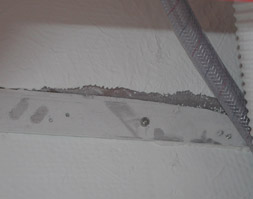
Deck join as seen from inside.
The framing system is something to behold. I was shown drawings of it since you can't really see the whole framing system. Larry didn't want me to publish the drawing because he considers this proprietary. If the competition wants to copy his methods, they'll just have to buy one of his boats and cut it apart.
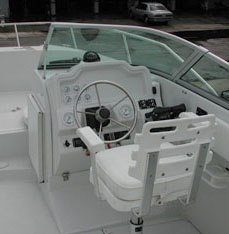
There is storage space galore on this boat, most of it in under-hatch bins. There is an insulated cooler in the hatch built around the helm chair, and two monster hatches in the forward cockpit. Speaking of which, while there are seat cushions up there, guests will be actually sitting on the deck. It seems designed here for bone or Tarpon fishing.
Rod racks are built into the starboard gunwale, and the gunwale width has been substantially increased, to give an excellent foot cove for the fisherman. The one drawback for the fisherman, of course, is the very high gunwale height.
In the complaint and carping department, I found the helm chair to be too close to the wheel and the sharp edges of seat were cutting into the backs of my legs. There were also some pretty sharp edges on parts of the windshield that Larry said he'd address. Then it was found that a large amount of water was puddling on the deck under the port side seating/bar module, but we couldn't figure out why, or where it was coming from.
The only serious design complaint I had, one which I suggested to Larry that he consider for future modifications, is about the integral motor mount platform. In the Florida market, where boaters spend a lot of time IN and not just ON the water, most platform extensions are designed as swim platforms. This one is not, for the hull sides extend all the way aft, and it has fairly deep wells on each side that prevent it from effectively being used as a swim platform. A well designed platform extension is a major selling feature in the Florida market, that this boat lacks. It needs a flat deck back there with no wings on the sides.
There are other standard goodies I took note of like chrome bronze through hulls ABOVE THE WATERLINE, stainless pop up cleats for tying off fenders, recessed hatch hinges, bolted on, not screwed. Sump wells with bilge pumps in the large deck boxes. Except for the inspection ports, all hardware is stainless, no plastic junk. The windshield is all glass, even the cured sections, unlike most which have plastic.
The mold fairing is not flawless, but darn close. The detail work is quite good. Overall, I thought this to be a well above average quality boat. If you're interested in catamarans and haven't looked at or taken a test run in a Glacier Bay, you should put this one at the top of your list to check out. Even if your not interested in cats, this boat may change your thinking about catamarans. It certainly changed mine, though to be sure, all catamarans do not perform as well as this one by a long shot.
Test boat provided by:
Seven Seas Yacht Sales
1500 W. Broward Blvd.
Ft. Lauderdale, FL
954-463-8143
Posted October 4, 2000




 Visit davidpascoe.com for his power boat books

David Pascoe is a second generation marine surveyor in his family who began his surveying career at age 16 as an apprentice in 1965 as the era of wooden boats was drawing to a close.
Certified by the National Association of Marine Surveyors in 1972, he has conducted over 5,000 pre purchase surveys in addition to having conducted hundreds of boating accident investigations, including fires, sinkings, hull failures and machinery failure analysis.
Over forty years of knowledge and experience are brought to bear in following books. David Pascoe is the author of:
In addition to readers in the United States, boaters and boat industry professionals worldwide from nearly 80 countries have purchased David Pascoe's books, since introduction of his first book in 2001.
In 2012, David Pascoe has retired from marine surveying business at age 65.
On November 23rd, 2018, David Pascoe has passed away at age 71.
Biography - Long version