



BERTRAM 30 Express
by David Pascoe
| LOA: | 30' 7" | Engines: | Yanmar 300 hp |
| Beam: | 11' 4" | Cruise range: | 22-26 knots |
| Draft: | 2' 6" | Top speed: | 30 knots |
| Fuel: | 225 gals | Options: | Crus, Merc 454's |
| Production years: | 1983-1985 | GM 8.2L diesel |
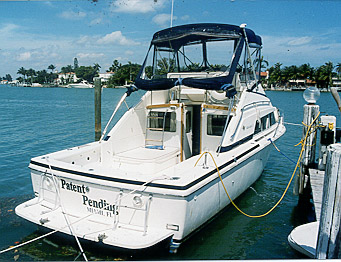
Finally! Here's a boat that we've been looking to review for years now. The reason we haven't is because it's a rarity, in production for only three years, and only several hundred built. We last ran into one about 6 years ago and was immediately impressed with it. And haven't seen another one since. Boo.
Express? Well, the express style has changed over the years, but that doesn't seem to be the right term. Chris Craft called their similar model a "sport cruiser" and that's more appropriate, for this one doesn't resemble anything commonly known as an express, now or then.
In production only three years? Gee, the boat must be a turkey or something, huh? Admittedly at the time it was not a great seller, reportedly somewhere just above two hundred. But these days there is a much larger market for this style than there was back in 1984. Plus, it was more likely the high original price that caused it to be a drag on the market, rather than the style. Frankly, I think this boat has everything that the Bertram 28 does not, yet the 28 today is still quite popular.
Our review model was provided by Pete Simonson of Miami who bought her four years ago and promptly ditched the DD 8.2 litre turkeys that it came with, repowering her with a new pair of Yanmar 6LP-STE, 300 hp diesels. These engines fit nicely and push her along at top speed of 30 with a cruise of 25. Pete, an engineer, has worked out the efficiency curves and says the 25 knot cruise is ideal, pushing the 3800 RPM diesels at only 3000. At 16,500 lbs it's not particularly heavy, nor very light.
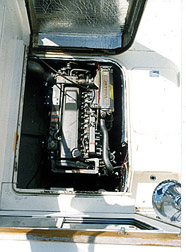
Ergonomics aren't the best, but at least there's adequate room. A nice fit for a pair of sixes.
Nor does she have the typical Bertram super deep vee hull that the builder is famous for, it's similar to the 33. He readily admits that a 3 foot sea causes him to throttle back, but still says she handles better than most. While we didn't get to test her out in weather, Pete says that she's remarkably dry. With all that bow flare, it ought to be.
The 30 Express is everything that the 28 is not. Only two feet longer, volumetrically she's much bigger, including breadth and depth and height. Overall, it's a very comfortable boat for two to spend some time on, whereas the 28 is really a day boat. Pete should know because he's had "Patent Pending" all over the Bahamas and has run up 750 hours on the new engines in only two years.
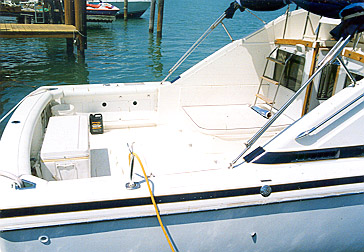
Nice flying bridge and large cockpit is what this boat is all about. Definitely for the outdoorsy types, its greatest appeal is to divers and fishermen. In other words, it's a tropical type boat, and that's what Bertram designed it for. For seating a lot of people on the bridge, this is the wrong boat. This one's got the motor boxes that are raised up above the deck by only about 8 inches, which makes it a good place to sit or recline, yet are not high enough to really get in the way. For people unfamiliar with the boat, there's tendency to trip over them.
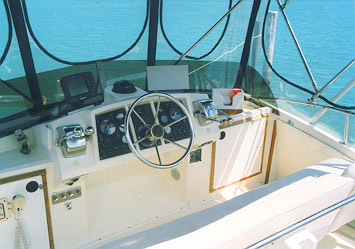
The bridge is the single bench seating type that's good enough for three, maybe four, but that's it. The helm console is adequately large with plenty of space for external mount electronics, but not much space for the more modern flush mount types. Much of the bridge space is achieved by making much of the helm area vertical, which causes the controls not to be well positioned.
Accessibility in the engine spaces with these engines, and the standard Crusader 454's is quite good, including with a 4.0 kw Onan generator plus a single Cruisair air conditioner unit. With the diesels, I could even climb outboard of the engines. The Onan is toward the aft end of the compartment and has a removable deck section above, but is intended to remain sealed.
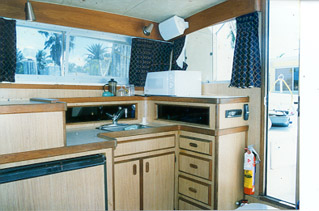
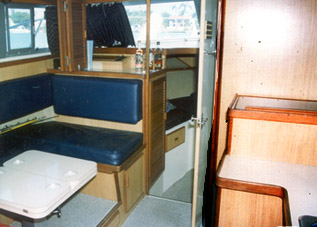
Mica city, but it is durable. An unusual U-lounge with lots of storage below.
The cabin has the usual vee berth forward, followed by a largish shallow but long U-shaped settee with table in center that easily converts to a large berth. Opposite is a decent sized galley area with a fair amount of counter space that is more than sufficient for preparing meals. There's also quite a bit of storage space and a fairly large, and not one of those dinky, under-counter reefers. The head, while smallish, is adequate.
With a glass windshield forward, there's a sense of greater space than there really is. The window height is only 16". This keeps out a lot of sun while letting in plenty of light but not difficult to air condition with a single unit, which this one was. One interesting feature is that caught my attention is that only one side of the forward windshield is an opening type, while the other side is fixed. And while leaky windshields are always annoying, I'll take the leaks and the vastly improved ventilation you get from it over a hot, stuffy cabin any day. There are always a lot of times when you can't, or don't want to run the air.
In terms of overall quality, I wouldn't give it any trophies, though it stands taller than most. The original fiberboard cockpit side liners have now all been replaced with Starboard plastic panels. Some of the deck moldings are not as strong as they should be and there are some distortions around the engine boxes. Stress cracking is fairly common in all the usual places, including along the rub and toe rails. And oh, that lovely Bertram aluminum rub rail that Pete now has scheduled for a costly replacement with stainless on top of solid plastic. He's going to do it like it was done in our MARLIN MONROE review. It should look great when finished.
The hull is solid glass all around with the usual balsa cored decks that are holding up fine. The deck is screwed to the hull but it has a wood backing on the inside that helps prevent the screws from shearing through the glass and loosening, as is so common when decks are just screwed on.
Overall, it's hard not to be impressed with the simplicity of things and the general ease of maintenance. One diligent person could keep up with it easy enough, even 16 years later if starting out with a boat in fairly good condition.
You'll be interested to know that this same hull is once again being offered by Bertram as the 30' Moppie model, with a redesigned superstructure that lacks the house with windows, instead being replaced with a large, raised coaming and windshield. Basically an open fisherman. But the point I wanted to make was the opening bid on the new model starting at $151,600 and gas engines. By the time you're done fitting out, you're looking at a $225,00 thirty footer. By comparison, our 1984 listed for $87,000 with diesels sixteen years ago. Today, this boat has a resale in the upper $80s to low $90's.
This boat will perform slightly better with 454's rated at 330-340 hp, but she's a dream boat in that either Cummins or Yanmars fit nicely and provide plenty of speed without the need for hot rod diesels that may blow your budget. You should be able to pick up decently maintained boats in the $60's so that in adding the cost of repowering, you still end up well under one hundred bills without falling overboard in terms of resale. Add new engines and you should be able to net your full repower investment cost, or very close to it, with little difficulty.
And by the way, in checking our records we note that over the last 6 years, there has been NO decline in resale value whatsoever. A nice, clean boat that sold for $60k in 1994 still sells for the same price!
Deals like that are hard to come by, which is what makes boats like this so attractive. It's old, but stands the test of time with adequate quality, timeless styling, and a name that wouldn't embarrass anyone. Plus, you can still add extras without getting in too deep. Add air or a genny and you still won't take a bath unless she sinks after your insurance policy has lapsed. If you find boats that either of these amenities, there's plenty of space for both.
With fuel costs predicted to hit $2/gallon in the summer of 2000, this is a great choice for those contemplating scaling down their appetites for something larger, newer or more expensive, due to rising fuel costs.
Overall, this is not a 5 star production boat, but the economics of it certainly rates a five.

Posted March 20, 2000





 Visit davidpascoe.com for his power boat books



David Pascoe is a second generation marine surveyor in his family who began his surveying career at age 16 as an apprentice in 1965 as the era of wooden boats was drawing to a close.
Certified by the National Association of Marine Surveyors in 1972, he has conducted over 5,000 pre purchase surveys in addition to having conducted hundreds of boating accident investigations, including fires, sinkings, hull failures and machinery failure analysis.
Over forty years of knowledge and experience are brought to bear in following books. David Pascoe is the author of:
In addition to readers in the United States, boaters and boat industry professionals worldwide from nearly 80 countries have purchased David Pascoe's books, since introduction of his first book in 2001.
In 2012, David Pascoe has retired from marine surveying business at age 65.
On November 23rd, 2018, David Pascoe has passed away at age 71.
Biography - Long version