



Aquasport 215
1999+1
(Outboardus Kindaniceus)
by David Pascoe
The problem with the year 2000 is that it looks like a model number.
Walking through one of those mega boat dealerships these days, there isn't much that stands out anymore as boat builders seem to fall over themselves imitating automakers in the mad race to make everything look alike. A zillion builders, but whatever they make, they so blend together that nothing is distinguishable.
So when I was driving out of the parking lot, this blue hull caught my eye and brought my tires to a screeching halt. Immediately a number popped into mind, a number like, oh, say 1974. It was that high, angular windshield, see. Windshields these days all seem to be shaped more or less like Maseratis or Jaguars, not like 1974 Sea Crafts. But moving a little closer, a few other things caught my attention as well. Never mind that the hull could have been rediscovered with the use of a time machine, here was a bow-rider outboard that looked like a clone between a gadabout and a fish boat.
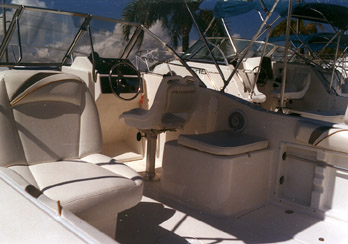
On the one side of the cockpit it has a back-to-back seat, the kind that slides down into a, uh, well, I don't know what you call it. Perhaps a lounge. Actually, no one ever seems to use these things -- at least not where one can be seen. But these things used to be standard equipment on all such outboards twenty years ago. Not that anyone really liked them, especially when the plywood frames started falling apart. This one has a fiberglass base, for whatever that's worth. Figured they wouldn't be pleased if I started ripping the seat apart to see what it was made of. So I didn't.
Now on the helm side it has a single pedestal seat with a molded in baitwell/storage box with a seat cushion on it. Looks like a bit of genetic engineering here. Runabout on one side, fisherman on the other. The removable cushions on six out of seven seats is a good idea. If you remove, stack and cover them when not in use, they'll last a long time. The luxuriously upholstered lounge seat is another story. Upholstered gunwale padding? Something less than a good idea come three years down the road and you see what they look like then. Replacement cost? More than anyone is willing to spend.
There are a couple of other nice touches, like a real honest to goodness bow railing, and a stand-up Bimini with extra rear braces instead the usual straps. And shock of all shocks, the dang through hull fittings are chromed bronze instead of self-destructing plastic. Somebody musta made a mistake. Those things probably cost $10.00 each!!! Poor guy is probably out looking for another job.
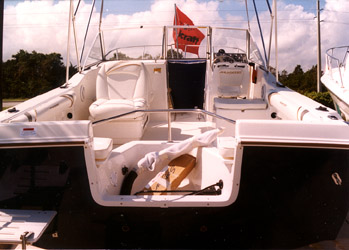
Then there's the motor well, a design which I've seen maybe once or twice. As you can see from the photo, it is a small cofferdam built around the transom recess. With a railing around it. Keeps passengers from falling into the motor when underway. Then it has a bench type seat with removable cushion on either side that is not the full depth of the well. Very unusual but also very effective in making best use of available space while still providing seating and storage.
So what gives me the idea of fishboat and not just sportabout? Well, those rod racks molded into the cockpit liner on both sides, and the amount of floor space in the bow area where it provides more room for fishing than sitting. Stand up casting, that sort of thing. The stand up height was about what it should be so that one is not attempting to steer with a wheel down around one's knees.
Another interesting feature: No sports car helm. It's tall, large and angular, like somebody got the bright idea that the operator might want to stand up and steer. Not something that looks like it got to close to a fire and melted. Not Buck Rogers, not Edie Bauer. More like Barnacle Bill. The whole arrangement is designed for practicality, to be used conveniently, and not to make brochure pictures more attractive while proving to be utterly worthless.
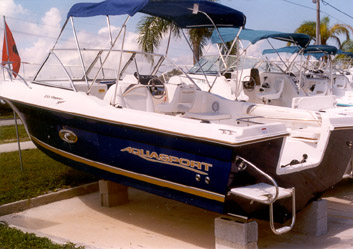
Notice the deep vee hull, a good 23 degrees. A rarity on this size boat these days.
Now about that tall windshield, thing is you could put some instruments up there without expecting them to get doused with water and ruined the very first time you use the boat. You can also duck behind it to dodge the spray, or put your wallet and other goodies up there to be protected. It may not be stylish, but it is surely practical. And of course it is the primary hand hold for those of us who can't sit down in a slamming boat. Seats in small boats are nice, but you mainly sit down AFTER you come back through the inlet into calmer water. Assuming you're not just running around on a small lake.
Overall, I though this looked like a pretty sensible compromise for an all-purpose runabout. And for it's size, it has a lot of storage. The one thing that was glaringly not sensible is the use of a soft plastic rub rail with a soft plastic insert. Rub rail? No, you don't dare let that delicate piece of plastic rub against anything but cotton or wool. Certainly not a creosoted, splintery wood dock piling.
Another problem is -- again, sigh -- holes in the motor well below the level of the transom. (See above photo) Drains get plugged, well fills up, water goes into hull. Bye bye boat. This is easily fixable and they need to fix it. Fast.
We didn't get to bash it about with a hammer, but if you're looking for something that's more sensible than stylish in this size boat, this one might be taking a close look at. But if you buy one and live in Florida, best to forgo the dark blue hull. It will fade out beyond restoration a couple years.
Posted Nov 5, 1999
content main


 Visit davidpascoe.com for his power boat books


David Pascoe is a second generation marine surveyor in his family who began his surveying career at age 16 as an apprentice in 1965 as the era of wooden boats was drawing to a close.
Certified by the National Association of Marine Surveyors in 1972, he has conducted over 5,000 pre purchase surveys in addition to having conducted hundreds of boating accident investigations, including fires, sinkings, hull failures and machinery failure analysis.
Over forty years of knowledge and experience are brought to bear in following books. David Pascoe is the author of:
In addition to readers in the United States, boaters and boat industry professionals worldwide from nearly 80 countries have purchased David Pascoe's books, since introduction of his first book in 2001.
In 2012, David Pascoe has retired from marine surveying business at age 65.
On November 23rd, 2018, David Pascoe has passed away at age 71.
Biography - Long version