




BLISTERS AGAIN?
The Wonderful World of Hull Blistering And Other Interesting Scams
by David Pascoe
Not long ago a marine surveyor wrote a letter to the editor of a boating publication. In that letter he indicated that it was his experience that prior to around 1970 he had encountered very few fiberglass boats with bottom blisters. Then, suddenly in the mid 1970's, bottom blistering seemed to blossom into a chronic problem throughout the boat building industry.
He further wondered if the 1973-4 Arab oil embargo, which dramatically raised the price of oil (and therefore the price of plastics) for a year or so, didn't lie at the heart of the problem.
Background
Since then other writings on the subject have appeared, and other surveyors have been heard to make similar comments. Indeed, hull blistering was not a major problem since the first fiberglass hulls were built in the late 1940's, until the advent of mass production on a large scale beginning around 1970.
Mass production of small boats began in the mid 1950's, larger boats starting in 1960 with the advent of Bertram, Hatteras and Hinckley. The transition from wood construction to fiberglass was nearly completed by 1970, at which time very few wooden boats were being built.
These comments caught my attention because it had also been my perception that very few boats ever developed hull blisters prior to the mid 70's. This is not to say that hull blisters never occurred prior to this time, because they did.
In fact, one of the very first reinforced plastic hulls built in the 1930's developed all sorts of problems, including what has been described as blistering.
But those problems have long since been solved and there is no excuse for the wide scale blistering of hull bottoms that occurs today, despite the absolute knowledge of every boat builder of what materials to use to avoid blistering.
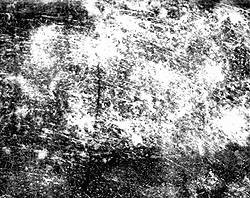
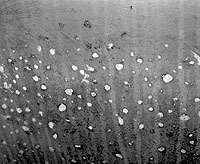
Left (or Top): Photo of hull with gelcoat
removed, revealing that the mat is very poorly wetted.
Right (or Bottom): photo of same area prior to removing gelcoat. Pimple blisters are
all beneath gelcoat and not under the mat, none of which grew to
any significant size.
The fact is that boat bottoms blister because builders knowingly make the decision to the cheapest possible resins to reduce their costs. Build a boat with better quality resins, resins that are not water permeable, and they will not blister, barring other major production faults. This is the reason why some boats blister while others do not.
Some surveyors have been insightful enough to ask why it is that some boats of a particular builder blister, while others of the same builder do not. Or even why it is that some boats in a model line will blister and others not. Here the answer is a little more complex.
One answer is that because resin constitutes such a major part of the overall materials cost in building a boat, many builders - if not most - are constantly in the process of shopping price and changing their resin suppliers based on the best available price.
Another part of the answer is based on a process that was once known as "tank coating." This was a process borrowed from the fiberglass tank industry, the people who made underground storage tanks for things like gasoline storage at gas stations. In the days before fiberglass tanks, the use of steel tanks underground was a major problem because of ground water that would rust them out. Thus, the fiberglass tank industry was the very first major use of fiberglass reinforced plastic. And it was here that blistering first became a problem.
If you're old enough, you may remember a time in the 1960's when every gas station in town seemed to be digging up their tanks and replacing them with fiberglass. That's because leaking gas tanks mean big trouble.
But then there was a period when they were digging them up again, this time to replace leaking tanks caused by blistering of the tanks. Interestingly enough, the first fiberglass tanks that were built did not leak. But then the cost of the plastic resin was high and the tanks expensive. Naturally, to reduce the cost, cheaper resins were developed and sold. So now the trouble begins.
By the mid 1960's tank manufacturers found an agreeable compromise. They would use the high quality resin on the outside of the tank (the part exposed to ground water) and the cheaper resins for the inner layers of the laminate, hence the term "tank coat."
A decade later, the plastic pool and spa industry encountered the very same problem and solution. Unfortunately, when applied to boat building, tank coating generally causes more problems than its worth. It makes the process of layup more complicated and prone to error. When only a limited number of boats in a builder's line develop blisters, it is the result of an error, i.e. the lay up crew using the wrong resin.
Now comes an interesting aside. Since Bertram, Hatteras, Chris-Craft and Hinckley were the first large fiberglass boat builders, the history of these builders on the subject is interesting.
For the most part, Bertram and Hinckley boats did not develop blisters. Hinckley is reported to have had none, while Hatteras, as we know so well, has had chronic blistering problems for nearly 30 years. Chris-Craft, on the other hand, only had occasional boats with blisters, but those that did were often extremely severe. I know of three cases where the blisters were so bad that they nearly destroyed the hull. Interestingly, the Bertram line rarely had blisters, and those that did were never known to be severe.
Both Bertram and Chris-Craft used the "tank coating" method of applying high and low quality resins strategically in hull construction, as decribed previously. In contrast, Hatteras had long been known to use both low quality gelcoats and resins because it was their method to paint their boats rather than use the gelcoat for the finish. Now consider which company has the worst track record on hull blistering.
But boat builders, a decidedly peculiar bunch of people who seem to insist on the notion that knowledge and education are not essential elements of their industry, went merrily on their way using inferior materials in the construction of their boats, just as large numbers continue to do so up to this very day.
Failures of Blister Solutions
And so here it is in 1997 that we still have millions of late model boats continuing to develop blister problems. (To those of you who wrote me regarding prior articles telling me that I was full of horse manure, please tell me why outfits like Bertram and Hinckley have built boats for over 30 years that did not blister. Please, I'm eager to know your answer!)
Now come those very same chemical companies who manufactured and sold those inferior resins to the boat builders, selling to boatyards some solutions to the very problems that they created in the first place.
What has prompted me to write this article is the growing number of failures of blister solutions that I have been recently encountering. No, I'm not talking about do-it-yourself jobs, but repair jobs performed by professional boat yards costing $10,000 or more.
In the first three months of this year alone I have encountered four yachts of over 50' that have failed blister repair jobs that involve the materials and systems of the major chemical and paint companies. These are not isolated incidents, but a major trend in the business of blister solutions.
In three of the four instances, the new bottom coating system literally turned to mush. The material turned so soft that it could be peeled off with a knife. I stress that these were reported to be the systems of well known manufacturers applied by professionals.
The owners stated that these were the materials systems of major chemical or paint companies. Moreover, the rates of failure of repair jobs on smaller boats, most of which I was not much interested in investigating finding out who and why, is actually becoming commonplace. However, many of these problems have to be attributed amatuer or cut-rate repair jobs of the grind-and-fill variety.
The question we have to ask is what the heck is going on here? How is it that the solutions are beginning to appear worse than the problem itself? No doubt that a large number of these failures were the result of less than professional workmanship, driven by the desire for low cost. This does not, however, explain the failure of very costly, professionally applied solutions.
Some Interesting Evidence
Since I don't have a few million dollars to spend on performing thorough research (as the chemical companies do), I certainly don't have all the answers. But my investigations have turned up some very interesting evidence:
-
It is not possible to effectively solve the blistering problem of a hull that is water permeable.
-
Water permeability of a laminate is not the function of a resin alone, but how well the glass fibers are saturated or wetted out with resin. If a hull is permeable from the outside, its also permeable from the inside. What is the point of recoating the outside when the inside is also exposed to water? (Related article: Illustration of Water Absorption from a Hull Interior.)
-
Blistering on above the waterline structures proves that immersion is not necessary to cause blisters.
-
We learned from the Uniflite class action suit in the early 1980's that continuous strands of glass fiber are capable of conducting water along their entire length by means of the capillary effect.
For example, if a roll of roving is laid out from one end of the hull to the other, and the wet out is not good or complete, those fibers can wick water along the entire length of the sheet of glass.
-
We also learned that engine vibration transmitted to the hull is one of the major means by which water is transmitted through unsaturated strands. Capillary effect alone is not responsible.
-
In a four year casual study that involved examining every hull that I ran across that had the outer coatings removed (involving hundreds of boats), the lack of complete wet out was appallingly bad in well over 50% of all boats that I looked at.
The nearby photo typifies the lack of wet out found in most boat hulls. There is a direct correlation between low quality resins and poor wet out on blistering.
-
The use of chopped strand mat as a skinout layer to prevent telegraphing of weave patterns through the gelcoat is a major source of the problem of water absorption of the hull. This is because mat does not wet out well.
Further, because the fibers are short, there are millions more exposed ends of fiber bundles capable of wicking and conducting water through the laminate.
Heavy layers of mat are very hard to fully saturate with resin. It is also responsible for causing millions of small voids that ultimately fill with water. Its almost like a wood boat that has millions of tiny worm holes.
-
Exposed fibers on the inside of the hull are also responsible for wicking water into the laminate. There is a definite correlation between where blisters most commonly occur and where bilge water lays within a hull. There is also a correlation of the predominance of blisters and the edges of sheets of glass fabric.
-
Major blistering problems are often related to bonding failures of both gelcoats and skin out mats. I was not aware of this until about a year ago, when, one day, I watched a blister repair contractor stripping the gelcoat from a hull.
Not only was the gelcoat coming off, but the entire skin out mat was peeling off (see actual photo of this boat). On closer examination I found that major areas of the skin out mat had never achieved bonding and could be peeled off by hand. As I continue to examine boats for this condition, I am finding more and more of them.
-
Examining the process that yards use to remove the blisters, it is found that most keep grinding away until they stop seeing any evidence of delamination. The problem that they often run into is that the delamination never stops.
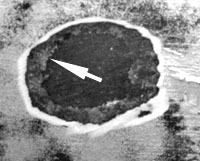
In this ground away blister, the ply separation is clearly evident around the perimeter as shown by arrow. When it is repaired, the void or incomplete bonding will remain.
The above photos reveals some of the conditions I have found in the vast majority of all blisters that I have examined (thousands). That is that most blisters involve ply separations that seemingly never ends. They grind and grind and grind, but there's always separation around the circumference of the blister.
-
When ply separations or incomplete bonding exists, blistering is a problem that cannot be solved. That's because the void areas are going to fill up with water all over the bottom. Repair the blisters and they will reappear because its not possible to keep water out of a hull that's constantly immersed in water.
Why Bonding Failures Occur
There are two types of bonds that occur in the laminating process, mechanical and chemical.
The former occurs when a wet laminate is laid over one that is dry or cured; the later when the new laminate is applied over one that is wet or at least tacky. In the later case the resins "fuse" together to form a whole.
A mechanical bond is simply a glue joint and is based entirely on adhesion and is not nearly as strong. In the normal course of laying up a hull, there is a natural stopping point in the process, this being just after the skin out is laid in (a "skin out" is the first layer, usually mat, laid up against the gelcoat sprayed into the mold). Not always, but it does occur frequently because it is not perceived as being very important to have a chemical bond at this point.
After all, the builder reasons, this part is not considered as structural: it just has to do with the finish. Particularly in small companies, the lay-up often occurs in a dirty environment, not infrequently with the carpenter shop nearby and saw dust filling the air. In other words, the bonding surface becomes either completely dry, contaminated or both, thereby resulting in an eventual bonding failure.
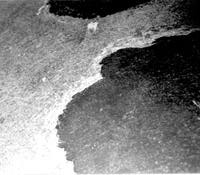
The skinout mat on this hull never was fully bonded. This is the result after six inch blisters were peeled away. This large section was peeled off with a screwdriver. Note that the mat is less than 50% saturated.
Because it is a weak glue joint, this bond failure may not occur until years later when the hull has been stressed hundreds of times. Certainly the effects of heating and cooling will play a major role in this as differing fiber configurations will cause differing rates of expansion and contraction.
These separations or incomplete bondings are otherwise undetectable in any other way. Sounding out the hull will not detect it unless the separation is complete, which it usually is not. Perhaps a better way to describe it is as a "partial ply separation" because there are many small areas where the glue joint is intact. Its rather like sprinkling sand on a piece of plywood and then trying to glue another piece to it. Parts will stick and parts won't and there's no rhyme or reason where or why except for the sand.
It follows then that a blister repair job on a hull where the skin out layer is not completely bonded is not going to be successful because the whole thing is a porous mess.
Just take a look at any hull that has had the gelcoat removed and the reason will be obvious. All those millions of white spots are voids or unsaturated fibers, all of which are going to conduct water via the capillary effect. And if most hulls have this condition (which they do), then we have a very good explanation for why so many blister repair jobs fail. It doesn't explain why the new coating systems turn to muck, but that's another story.
If you're a boat owner who has shelled out a lot of bucks to get your blisters fixed, and you're asking yourself why didn't anyone tell me this, then you're asking the right question.
The answer is that, like the boat builder who built your boat using lousy resin and layup techniques in the first place, the boat yard doesn't know because they're more interested in getting your ten grand than in knowing what it is that they're doing.
After all, if they knew they couldn't fix it, they'd have a more difficult time explaining why they took your ten grand. So ignorance is bliss unless you decide to sue them, which you probably won't do because it will cost you more than the value of the problem and if you lose, you're out even more.
And so the yard is fairly safe in continuing their ignorance because they can blame it all on the materials manufacturer anyway, who will point the finger back at them and you'll have to sue them both and hire a lot of expensive experts, if you can find any.
And so it is that after 50 years of boat building the blister problem just keeps rolling on and on, keeping surveyors like me in business telling people things they don't want to hear.
How to Tell a Hull Will Blister
No, the moisture meter isn't going to tell you whether a boat is likely to get blisters or not simply because most boat hulls are saturated with water. The reason why some blister and some don't is basically a matter of quality materials and good techniques. Even when saturated with water, quality hulls are far less prone to blistering.
If a hull is 5 years old or more and has no blisters whatever, there's about a 95% probability that it never will. If it has even one blister, the chances are very high that it will continue. The more blisters it has in inverse proportion to its age, the more likely that the problem will worsen at a progressive rate. Here's why.
Even though a hull may be built with inferior resin, osmotic pressure is not normally sufficient to force a separation between plies that are completely chemically bonded. If it can't force a ply separation, then the blister can't form.
In this case, if there are sufficient numbers of voids directly under the gelcoat (which softens with age), small blisters, or what I call pimple rash, will develop that will extend only to the general area of the void. The osmotic pressure is sufficient to raise the gelcoat, but not to cause a ply separation.
It is particularly insightful here to note that pimple rash almost never occurs in conjuction with larger blisters. Obviously, then, entirely different factors are at work in this case.
Larger blisters almost always occur under the skin out mat. This is also a point of great significance. If there are larger voids, or poor bonding generally, then, and only then, will serious blistering develop. If the wet out is very good (which is rather rare) then blisters are not likely to develop at all because there are no voids to help get it started.
If you're looking to buy a boat that's three years old and has ten blisters, figure that the problem will gradually worsen, possibly at a very rapid rate. On the other hand, what effect do the blisters really have? Are they going to destroy the hull as so many horror stories told by people wanting to take your money? No, hull blistering rarely causes structural problems unless it is unusually severe.
Can blistering cause problems in resale?
Yes, but even that is fairly rare. Its possible that a buyer will try to negotiate for the cost of a fix, but I haven't seen one in fifty sales rejected because of blister problems, and these have always been severe, and usually involving a prior failed repair.
Summary:
-
Don't rely on moisture meter checks to determine whether a hull is prone to blistering.
-
If blistering bothers you, don't buy a boat that has them.
-
If you own a new boat that's developed even just a few blisters, file a warranty claim immediately. Don't wait for it to get worse and the warranty to expire.
-
If the hull does have blisters, the existence of a bonding problem can be determined with a little destructive testing.
This can be done by using a long, thin-bladed knife. Slide it in beneath the surface of the blister and see if it slips in beyond the circumference of the blister. If the outer surface is loose all around, then there's a bonding problem.
-
Don't be sold a "fix" until you know the source of the problem. Small areas of the gelcoat need to be removed and determined whether there are excessive voids or poor wet out of the skin out mat. If there is, the usual "fix" isn't going to work.
-
If there is evidence of poor bonding, a permanent solution may involve peeling the skinout mat off the entire hull.
As you can see, causal factors of hull blistering is myriad and complex, all of which makes coming up with neat, tidy explanations impossible.
Ultimately, those surveyors who thought they saw a link between the oil price increases of the 1970's and hull blistering are half right. The price of oil does provide additional motivation for builders to use inferior resins, but that started long before 1973, and in industries other than boat building.
The problem is not going to go away because that motivation will always be there, combined with the fact that boat owners haven't been willing to hold the builder's feet to the fire. As long as the market is willing to accept the problem, there's not much incentive to change.
For any surveyors who might be reading, here's another interesting question: When was the last time you saw a 24' runabout with hull blisters? How come big boats get them and small ones don't?
Caveat emptor.

 Visit davidpascoe.com for his power boat books
 David Pascoe - Biography





David Pascoe is a second generation marine surveyor in his family who began his surveying career at age 16 as an apprentice in 1965 as the era of wooden boats was drawing to a close.
Certified by the National Association of Marine Surveyors in 1972, he has conducted over 5,000 pre purchase surveys in addition to having conducted hundreds of boating accident investigations, including fires, sinkings, hull failures and machinery failure analysis.
Over forty years of knowledge and experience are brought to bear in following books. David Pascoe is the author of:
In addition to readers in the United States, boaters and boat industry professionals worldwide from nearly 80 countries have purchased David Pascoe's books, since introduction of his first book in 2001.
In 2012, David Pascoe has retired from marine surveying business at age 65.
On November 23rd, 2018, David Pascoe has passed away at age 71.
Biography - Long version