



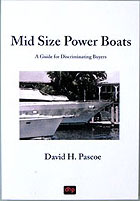

Introduction
Read Online Full Chapter 1

Full text from the book
Introduction
Having spent over three decades giving advice to buyers of both new and used boats, this book contains my answers to the most commonly asked questions.
Were this a simple subject, this would have been a short book, but it is not. Boats are probably the largest, most complex and costly consumer products that anyone can buy.
Because boats are so very expensive, it pays to perform considerable research before you buy.
Unfortunately, as most experienced boat buyers will attest, there are all too few good sources to turn to in order to get reliable information.
There are, of course, innumerable sources offering boat reviews, most of which nearly everyone recognizes as being little more than advertising puff pieces offered by writers associated with publications that derive their income from advertising. As with stock brokers, these are hardly objective sources of advice.
Mid Size Power Boats covers powerboats from around 30 to 55 feet or so.
Unlike most other books so styled, this book contains serious criticism of today’s boats and the boat building industry in general. In it we take an unabridged and detailed look at the good, the bad and the ugly.
My objective is not to offer gratuitous criticism, but to identify those factors that make for good and reliable boats, as well as those that don’t. We can only put what’s right into perspective by knowing what’s wrong, and why it’s wrong.
Gaining a knowledge about the industry, its strengths and weaknesses will help you make better choices. It is for that reason that I’ve gone to considerable length to explain why things are the way they are.
The truth of the matter is that the boat building industry is today, and has always been, a grossly undercapitalized and marginal industry.
Its products have never been, and never will be, as high quality and reliable as we’d like them to.
Boat building thrives in boom times but usually collapses and goes bankrupt during the lean years. The industry is, to say the least, unstable.
This is not anyone’s fault; this is inherent in the fact that boat builders produce our most expensive discretionary spending product, and are always the first to feel the effects of economic downturns, but are the last to recover after the economy does.
Many buyers, particularly first time buyers, figure that if they’re spending a quarter million dollars or more for a product, that they have a right to expect it to be reliable and of good quality.
This entire book is a testament to just how wrong that assumption can be.
My objective is to help the reader navigate his way through this swamp of industry economic difficulties that ultimately end up being reflected in the product itself.
In contemplating the purchase of a boat, the buyer has a lot of serious choices to make. While almost all boats look good, particularly new ones, the reality is that there are huge differences to be considered on issues of style and performance.
During the last decade, boat building has undergone huge changes in everything from the style of the boats it produces, the nature of its corporate ownership, quality and materials used in construction.
Many of these changes have not been for the better as the industry has largely consolidated into the hands of two big corporations — Brunswick and Genmar — which has resulted in increasing homogeneity, less in the way of product differentiation, more and more cookie-cutter boats that all seem to look alike, and fewer and fewer choices.
Not only have boat builders consolidated, but so, too, has the number of distinct styles of boats.
We’ve witnessed the express style boat come to completely dominate the market, while other styles, such as the motor yacht, almost completely disappear, a casualty of sophisticated marketing that induces all the lemmings to run in the same direction.
Corporate boat building has become affected by the same malaise as the auto industry — mind-numbing sameness.
Every year as many existing boaters give up boating as new people enter boating.
Studies reveal that over the last two decades the total number of registered boats has actually declined from a high of 22 million in 1987 to the current level of 19 million.
The most common reason expressed by those who sell their boats without buying another is a combination of boating being too expensive and too much work.
Therefore, one of the central themes of this book is how to identify boats that are more durable and less costly to own.
While one might think that boats have become progressively less maintenance intensive and less costly, the opposite has been true.
In large part this has been the result of the increasing demands for luxury and complexity of boats. People want all the bells and whistles. The average boat today is substantially more complex than it was twenty years ago, and more costly, too.
The cost of ownership is directly linked to quality and sophistication.
The fancier the boat, the more equipment and systems it has, the more it’s going to cost to keep all those things in good working order.
And quite naturally, when we demand low initial costs, it goes without saying that the quality of all those bells and whistles will also be lower, meaning that they aren’t as durable and ultimately cost more to own because it costs more to keep it all in good condition.
This book details a large number of mistakes that builders are prone to make.
At first, the reader may feel overwhelmed by the number of possibilities.
In planning this book, I had to make a decision whether to risk overwhelming the reader and possibly discouraging him, or leaving a lot of important detail out. In the end, I decided to err on the side of excess.
On reading to the end, the reader will, no doubt, come to see how it’s difficult for even a competent surveyor to check out all possibilities. Hopefully this will convince you of the need to hire a top notch surveyor before you buy.
David H. Pascoe
Destin, Florida
January, 2003
Copyright© 2003 David H. Pascoe
- Description
- Contents
- Introduction
- Place Order
 Visit davidpascoe.com for his power boat books



David Pascoe is a second generation marine surveyor in his family who began his surveying career at age 16 as an apprentice in 1965 as the era of wooden boats was drawing to a close.
Certified by the National Association of Marine Surveyors in 1972, he has conducted over 5,000 pre purchase surveys in addition to having conducted hundreds of boating accident investigations, including fires, sinkings, hull failures and machinery failure analysis.
Over forty years of knowledge and experience are brought to bear in following books. David Pascoe is the author of:
In addition to readers in the United States, boaters and boat industry professionals worldwide from nearly 80 countries have purchased David Pascoe's books, since introduction of his first book in 2001.
In 2012, David Pascoe has retired from marine surveying business at age 65.
On November 23rd, 2018, David Pascoe has passed away at age 71.
Biography - Long version